
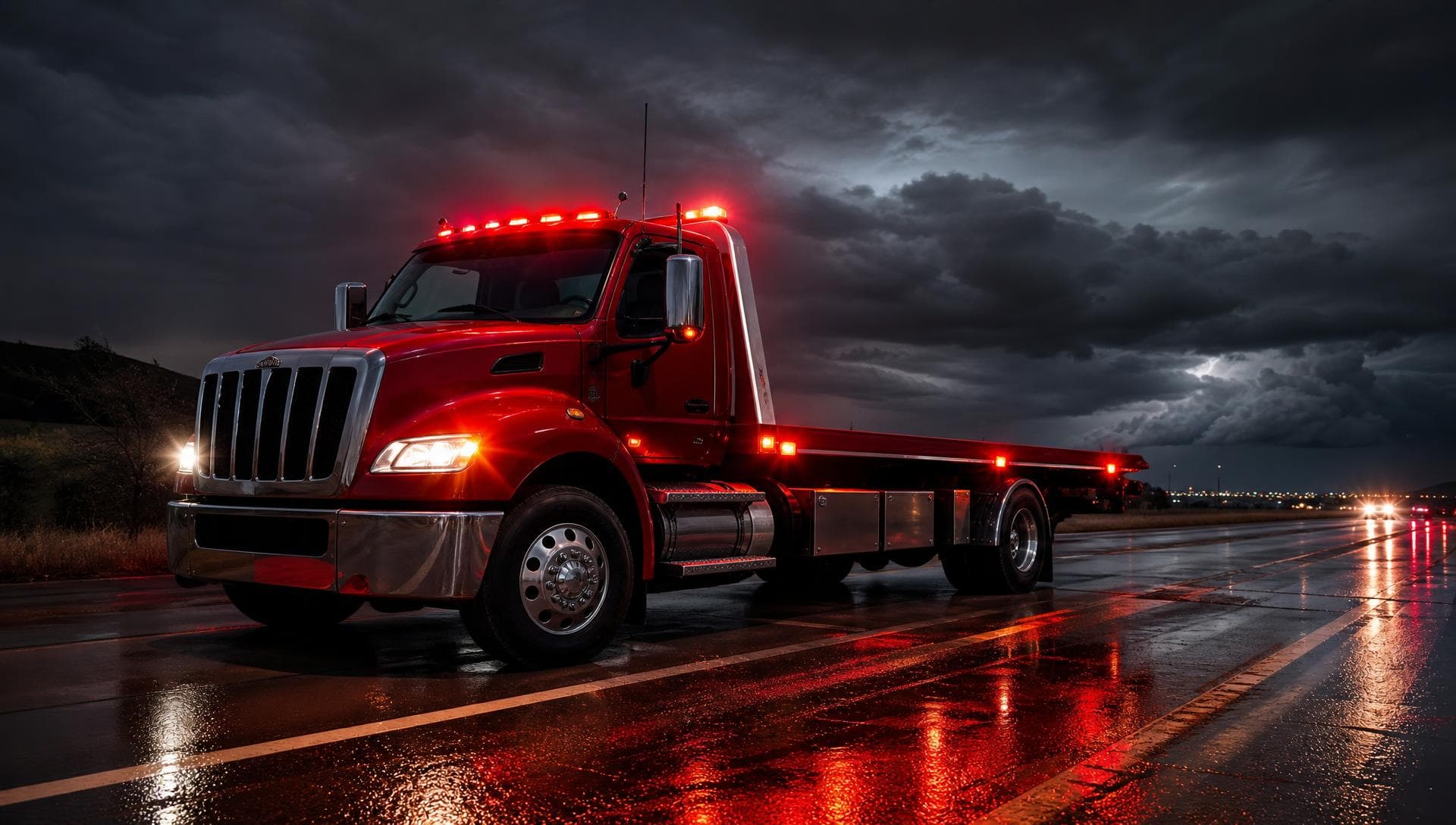
When your car breaks down on the highway, the first minute decides your safety and the next ten decide your night. Turn on the hazard lights, steer as far right as the car will go, and stay inside with your seatbelt on if traffic is fast and there is no barrier. If you must get out, use the passenger side. Then call: 911 if you are blocking a lane or anyone is hurt, otherwise a tow company or the DPS stranded motorist line.
I-35 through Round Rock and Pflugerville is one of the busiest stretches of road in Texas, and the shoulder is narrow in places. This guide is written for exactly that road, with the state's own numbers behind every recommendation.
What should I do first when my car breaks down on the highway?
The Texas Department of Public Safety publishes the sequence, and it is short on purpose. Do these in order.
- 01Hazard lights on the moment the car starts losing power. Visibility is the whole game.
- 02Get as far off the traveled lanes as the car will go. Coast to the shoulder, an exit ramp or a frontage road if you can. Do not stop in a lane if the car still rolls.
- 03Stay with the vehicle. DPS says to remain with the car until uniformed law enforcement or help arrives, especially at night or in bad weather.
- 04Exit from the passenger side only, away from traffic, and only if you have to.
- 05Make the car obvious. Raise the hood or tie a light-colored cloth to the antenna or door handle so passing drivers and patrols know it is disabled.
Source: Texas Department of Public Safety, Travel Tips (disabled vehicle guidance)
Note what is not on the list: standing behind the car, walking along the shoulder, or crossing lanes to the median. Every one of those puts you in the path of a driver who has not seen you yet.
Should I stay in the car or get out on I-35?
On a fast road with no barrier, stay in the car with your belt on. Get out only if the car is on fire, is in a live lane, or you can step straight over a guardrail to a safe area. Even then, leave through the passenger door.
The reasoning is in the crash data. Texas recorded 3,769 traffic deaths in 2025, and the year before, 768 of the 4,159 people killed on Texas roads were pedestrians. A person standing on the shoulder of I-35 at night is a pedestrian in every sense that matters to a driver doing 75 mph.
Source: TxDOT, Texas Motor Vehicle Traffic Crash Facts, 2025 and 2024 calendar years
The one exception is a car that cannot get out of a live lane. If you are stopped in traffic on the I-35 main lanes and the car will not move, that is a 911 call first, and you should get yourself behind a barrier if one is within a few steps. Leave the hazards on and leave the car where it is.
Who do I call when I break down near Austin, Round Rock or Pflugerville?
It depends on whether anyone is in danger. Use this order.
| Situation | Call | Why |
|---|---|---|
| Blocking a lane, injured, fire, or a crash | 911 | Law enforcement clears the lane and protects the scene. |
| Safe on the shoulder, need help but not an emergency | DPS Stranded Motorist Hotline, 1-800-525-5555 or *DPS (*377) | Answered 24 hours a day by a live operator. They dispatch help; the tow itself is still between you and the wrecker company. |
| On a monitored freeway in the Austin area | TxDOT HERO, 512-974-4376 | Free motorist-assist patrol for minor problems and traffic safety on covered routes. |
| Need a tow or a roadside fix, want a price first | A tow company you choose | You pick the company and the destination. Get the full price on the phone before the truck rolls. |
Source: TxDOT, Texas Road Tips Handbook 2024 (stranded motorist hotline and HERO numbers)
Two things speed up every call. First, know your location: the highway, the direction, and the nearest exit number or mile marker. Second, describe the symptom. A car that cranks but will not catch, a car that is silent, a flat with no spare, a gauge on empty. The symptom tells dispatch whether to send a roadside truck or a flatbed, and the price follows from that.
What is the Texas Move Over or Slow Down law?
Texas requires drivers approaching a stopped emergency vehicle, tow truck or other protected vehicle with lights on to either move over a lane or slow to 20 mph below the posted limit. Since September 1, 2023, a first offense carries a fine of $500 to $1,250, up from a previous maximum of $200. If the violation causes bodily injury it is a Class A misdemeanor, which can mean jail time.
Why this matters to you on the shoulder: a tow truck with its lights on is a protected vehicle, which means the lane next to your car legally has to clear or slow when the truck arrives. That is the safest window you will get. Stay in the car until the operator comes to your window, then follow their instructions on which side to exit. The operator loads from the traffic side every day and knows where the danger is.
What breaks down most, and can it be fixed on the shoulder?
More often than you would think. AAA handled over 27 million roadside calls in 2024. About 13 million ended in a tow, but roughly 7 million were battery problems, and flat tires and lockouts made up most of the rest. A large share of those were fixed where the car sat.
Source: AAA Newsroom, April 2025 (2024 roadside call breakdown)
- Dead battery. A jump start takes minutes. If the car dies again within a mile, the alternator is the problem and it needs a tow.
- Flat tire, no spare or no tools. A tire change with your spare, or a tow to a tire shop if there is none.
- Out of fuel. Enough fuel delivered to reach the next station. On SH-130 and the toll roads the gaps between exits are long; this is the most common toll-road call.
- Keys locked inside, or in the trunk. A damage-free lockout is a 15-minute job on most vehicles.
- Overheating, warning lights, strange noises. Do not keep driving to make it home. A tow to your mechanic is cheaper than the engine.
- Collision. A recovery goes to the body shop you choose. Do not sign anything with a truck you did not call.
The worst spots to break down on I-35 between Austin and Georgetown
Some stretches have a full shoulder and some barely have one. From the dispatch log, these are the places where calls take longest and where staying in the car matters most.
- I-35 at the Wells Branch interchange in Pflugerville. Congestion backs up through the interchange most of the day, so a disabled car in a lane becomes a hazard fast.
- I-35 between University Boulevard and US-79 in Round Rock. The shoulder narrows in places. Get as far right as the car allows, and do not exit on the traffic side.
- The SH-130 and SH-45 interchange. High speeds, long distances between exits. Note the last exit you passed before you call.
- I-35 through [Georgetown](/towing/georgetown-tx). Construction zones move, and a lane shift can put the shoulder somewhere other than where you expect. Use the exit ramp if one is within coasting range.
When you call, give the direction of travel and the nearest exit. On I-35 that is worth five minutes of searching. On the toll roads it can be worth fifteen.
How YAS Towing gets to you on I-35
YAS Towing is based in Pflugerville, right on the I-35 and SH-130 corridor, and runs both roads every day. Dispatch answers 24 hours a day and asks where you are and what the car is doing. Average arrival across Pflugerville, Round Rock, Hutto, Georgetown and Cedar Park is about 30 minutes, and you get a real ETA on the call rather than a guess.
The driver arrives with lights on, which clears the lane beside you under the Move Over law, and tells you which side to exit. If the car can be fixed on the shoulder, it is. If it needs to move, it goes where you say. What a tow costs in Texas covers the state rules and the numbers to expect anywhere in Texas.
Questions
Frequently asked
A disabled car on the shoulder is not illegal, but it can be towed by law enforcement if it blocks traffic or sits for an extended period, and that becomes a non-consent tow with storage fees. Raise the hood, leave a note with your number if you must leave it, and arrange a tow as soon as you can.
Only if you can place them without walking in or beside live traffic, which on most of I-35 you cannot. Hazard lights, a raised hood and a light cloth on the antenna do the same job without putting you in a lane. Leave the shoulder walk to the tow operator or the HERO patrol.
No. The DPS Stranded Motorist Hotline dispatches help, including law enforcement, but any tow that follows is an agreement between you and the wrecker company. Calling a company you choose directly lets you get the price first and pick the destination.
It depends on traffic and where the nearest truck is. YAS Towing averages about 30 minutes across Pflugerville, Round Rock, Hutto, Georgetown and Cedar Park, and dispatch gives a real ETA on the call. Having the exit number or mile marker ready shortens it.
Published Oct 19, 2026. Last reviewed Oct 19, 2026 against the sources linked above. Texas fee caps and statutes change; confirm the current figures with the Texas Department of Licensing and Regulation before relying on them. This article is general information, not legal advice.