
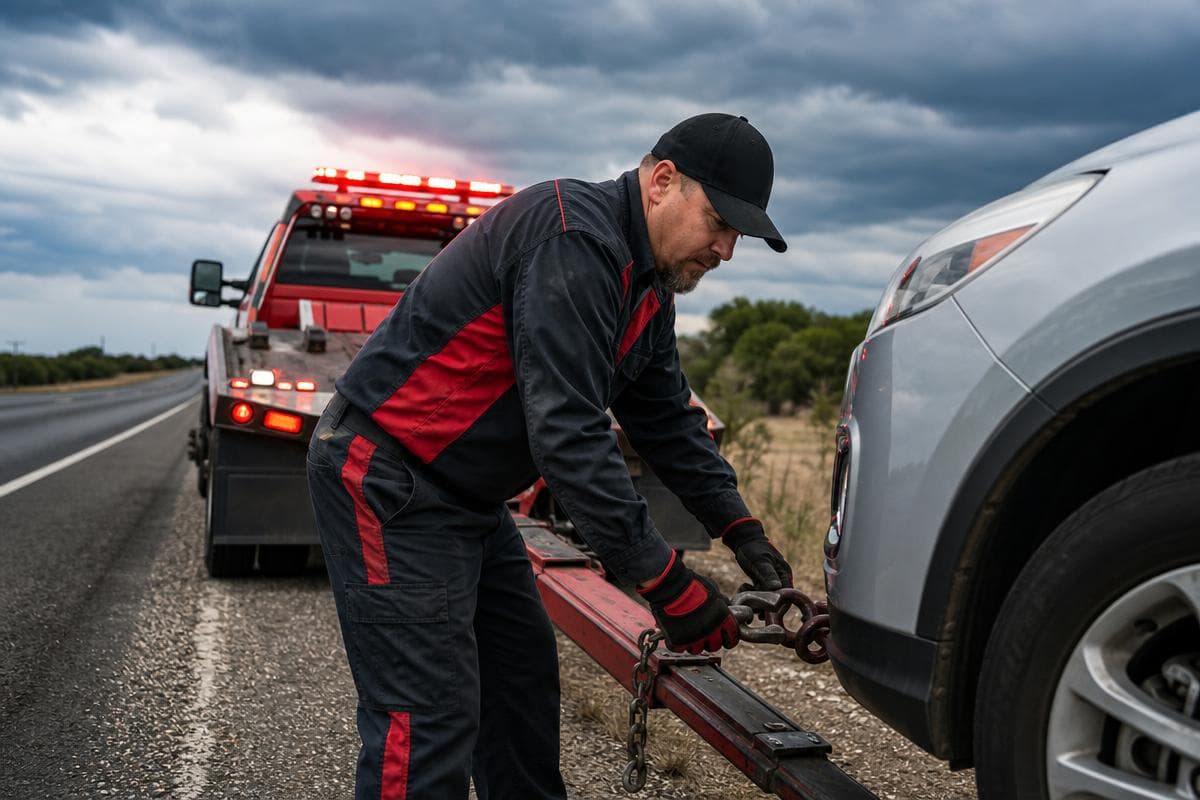
How much does towing cost in Texas? It depends on one thing first: whether you called the truck or someone else did. A tow you did not ask for, from a private lot or at police direction, is capped by the state at $272 for a vehicle up to 10,000 lbs. A tow you call for yourself has no cap. The price is whatever you agree to before dispatch, and distance, vehicle type and the service needed set the number.
Most people ask this question from a shoulder, at night, with a phone at 12%. So this guide stays short on theory and long on numbers you can check against the state's own pages.
How much can a towing company legally charge in Texas?
For a non-consent tow, the Texas Department of Licensing and Regulation (TDLR) sets statewide maximums by vehicle weight. For a consent tow, the one you order yourself, there is no legal cap. The price is a private agreement between you and the company.
| Vehicle weight | Maximum tow fee | Maximum drop fee |
|---|---|---|
| Up to 10,000 lbs (cars, SUVs, pickups) | $272 | $135 |
| 10,001 to 24,999 lbs | $380 | $190 |
| 25,000 lbs and over | $489 per unit, $978 total | $244 |
A drop fee is what you pay when the truck has fully hooked your car but has not left the lot. If the driver has not finished hooking up, Texas says you can take the car back for free, no proof of ownership needed. Cities and counties may set a lower cap than the state figure. They may never set a higher one.
Source: TDLR, Consumer Information about Towing (fee maximums and drop-fee rules)
These caps apply to the tow you did not order. If your car was pulled from an apartment lot in Pflugerville or Round Rock, read the guide to getting it back. It covers storage fees, what to bring to the lot, and the 14-day deadline to contest the tow in court.
How much does towing cost in Texas when you call the tow yourself?
A consent tow has no state price cap. The company quotes a price, you accept or decline. Four things drive that quote, and a good dispatcher will ask about all four before giving you a number.
- Distance. Where the car is and where it is going. A short hop to a shop in Round Rock costs less than a transport across the county. The honest way to price it is the actual route, not a zone map.
- Vehicle type. A standard front-wheel-drive car can go on a wheel-lift. All-wheel-drive, electric, lowered, luxury or damaged vehicles need a flatbed, which takes longer to load and costs a little more. It is still far cheaper than the drivetrain repair a wrong tow can cause.
- Service. Moving a car that rolls is one job. Pulling one out of a ditch is a recovery, priced on how stuck it is. Say what happened, not just where you are.
- Time and conditions. Nights, holidays and weather can affect the price. A straight company tells you that on the call, not on the invoice.
Published price lists are rare in this industry, for a reason that is only half honest. A tow from Hutto to a Round Rock shop and a transport from Georgetown to San Antonio are different jobs, so one number would mislead. That is the honest half. The other half is that some operators prefer you not know the price until the hook is on. The fix is simple: ask for the full price on the phone, and hang up on anyone who will not give it.
What does a roadside call cost compared to a tow?
Most breakdowns do not need a tow at all. A jump start, a lockout, a tire change or a fuel delivery is a flat-rate service call, usually a fraction of a tow, and fixed where you stand.
The numbers back that up. AAA answered more than 27 million roadside calls across the United States in 2024. Roughly 13 million needed a tow and about 7 million were battery problems. Between them those two categories made up around 74% of all calls, ahead of flat tires and lockouts.
Source: AAA Newsroom, April 2025 (2024 roadside call volume and breakdown)
The practical rule: describe the symptom on the call. A car that cranks but will not start is often a battery, a fuel issue or a sensor. A car that is silent when you turn the key is usually the battery or the starter. When the symptom fits, dispatch can send a roadside truck for a jump start, a tire change, a fuel delivery or a lockout instead of a flatbed, and the quote drops with it.
What do storage fees cost after a tow in Texas?
If your car ends up at a licensed vehicle storage facility, the state caps daily storage at $22.85 for vehicles 25 feet or shorter and $39.99 for longer vehicles. Those are the 2023 adjusted maximums and they still apply.
- A one-time notification fee of up to $50 for the letters sent to the owner and lienholders. It is waived if you collect the car within 24 hours or before the notice goes out.
- An impoundment fee of no more than $22.85, and only for specific documented work like tarping a broken window or inventorying loose property.
- No environmental fees, no notary fees, and no fee to get into the car for your documents or belongings.
- The facility must accept cash, debit and credit cards and must post a sign saying so.
Source: TDLR, Vehicle Storage Facility Fees and Other Charges
Storage runs by the calendar day, with one exception: a car on the lot across two days inside a 12-hour window is charged for one day. A tow you call yourself normally skips storage entirely, because the car goes to your shop or your driveway. That is the single biggest cost difference between a consent tow and an impound.
What are the signs of a predatory towing service?
The warning signs are consistent: no price before hookup, no itemized receipt, no license number, and fees that appear only at the scene. Texas gives you a checklist, because a non-consent tow ticket must carry specific information by rule.
- The driver will not quote a price before touching the car, or quotes one and changes it after hookup.
- A truck shows up at a crash you did not call and pressures you to sign. Choose your own company and your own body shop. Accident recovery should go where you say.
- The driver steers you to a particular shop. Kickback arrangements are common. You decide the destination.
- Hookup, mileage or fuel surcharges appear that were never mentioned. On a non-consent tow only itemized charges from the company's filed fee schedule are allowed.
- The tow ticket is missing the company's licensed name, phone number, certificate number or the operator's TDLR license number. All four are required on every non-consent tow ticket.
- The driver demands cash only for a drop fee. Texas requires the driver to accept cash, credit and debit for that charge.
Source: TDLR, Consumer Information about Towing (tow ticket and payment requirements)
Note the pattern. Nearly every predatory move depends on you not having a number before the hook is on. Get the number, and the rest of the playbook stops working. Who we are and how we got here is a short read if you want to know who is answering the phone.
Will my insurance or roadside plan pay for the tow?
Often yes, at least in part. Many auto policies include towing or roadside coverage with a per-incident limit. Some pay the company directly. Others reimburse you after the fact, which means you pay first and file later.
Ask three things before the truck rolls: does the plan pay the tow company or reimburse you, what is the per-tow cap, and does it cover the destination you want. Then keep the itemized receipt. A receipt that shows the date, the route and the service is what the insurer wants to see, and it is what a company with nothing to hide will hand you without being asked.
How to get a towing quote in Pflugerville and Round Rock
YAS Towing is a Pflugerville tow company covering Round Rock, Hutto, Georgetown and Cedar Park. When you call, have three things ready: where the vehicle is, what it is, and what happened. Those three decide the route, the truck and the service, which is everything a quote is built on. Ask the same of any company you call.
Payment is cash, credit or debit card. Dispatch answers 24 hours a day, and the people answering are local. For fleet, property or scheduled transport, send the details and we will call you back.
If you are reading this from the side of I-35, the breakdown safety guide covers what to do while you wait.
Questions
Frequently asked
There is no state figure for a tow you order yourself; it is priced by agreement, so ask for the full quote on the phone. For a private property tow, the state maximum for a vehicle up to 10,000 lbs is $272 regardless of the distance to the storage lot, and cities or counties may set a lower cap.
Most do. For a non-consent tow, Texas requires the driver to accept cash, credit and debit for a drop fee, and the storage facility to accept all three for every charge. For a tow you order yourself, ask on the call before the truck rolls.
On a non-consent tow, only itemized charges from the company's fee schedule filed with the storage facility are allowed, and TDLR's list of permitted charges does not include a fuel surcharge. On a consent tow, anything that was not in the price you agreed to is a dispute, not a valid charge.
Often it is not a tow. If the problem is a dead battery, a flat, an empty tank or locked keys, a roadside call fixes it on the spot for less. If the car has to move, a wheel-lift tow of a standard front-wheel-drive car over a short distance is the lowest-cost option. Check your insurance or roadside plan first, since many reimburse the cost.
Published Oct 19, 2026. Last reviewed Oct 19, 2026 against the sources linked above. Texas fee caps and statutes change; confirm the current figures with the Texas Department of Licensing and Regulation before relying on them. This article is general information, not legal advice.