
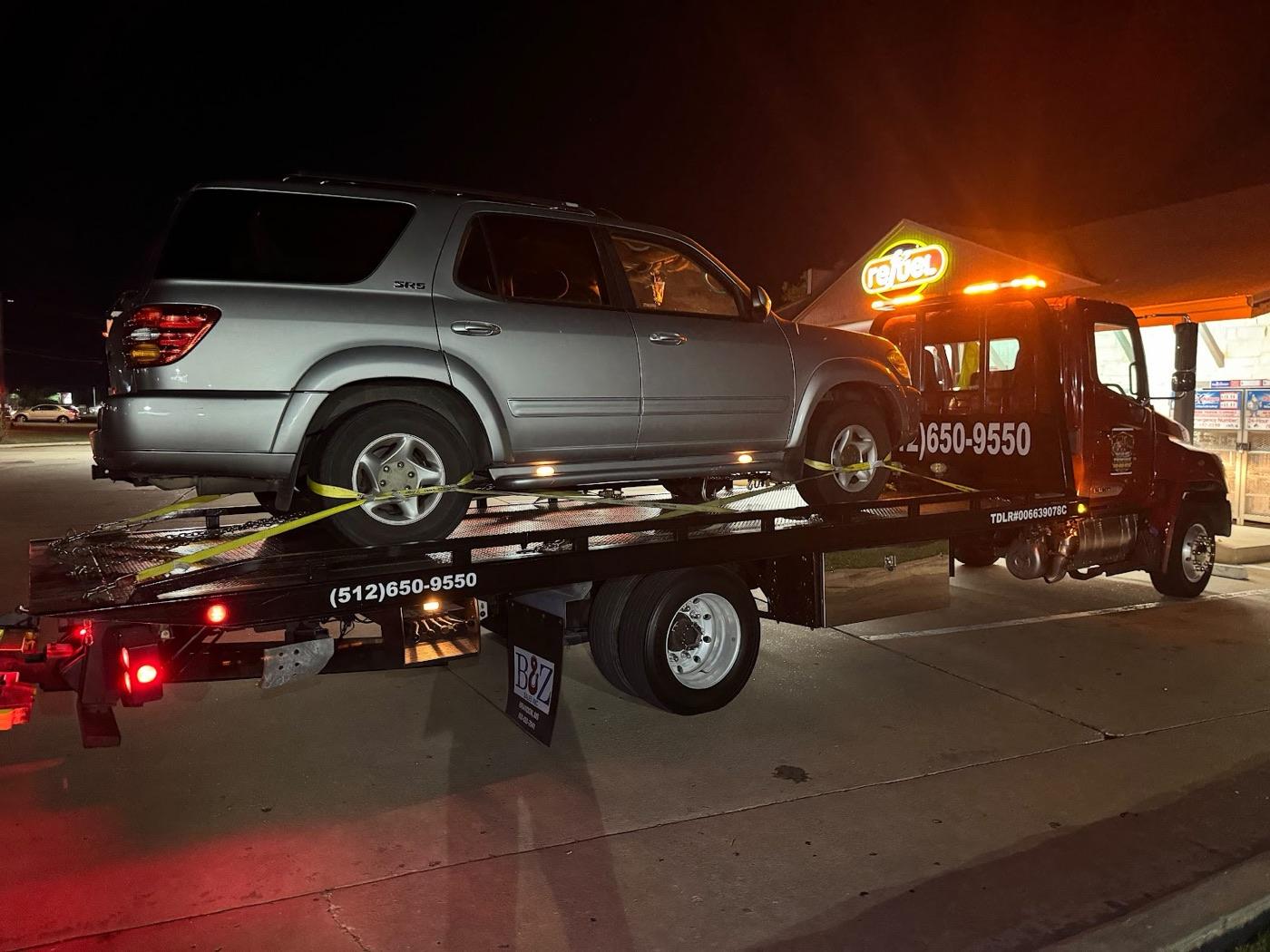
If your car won't start in cold weather, the battery is the first suspect. AAA reports that a battery loses about 35 percent of its strength at 32°F, while a cold engine can need up to twice the usual current to turn over. Listen before you call: clicking or a slow crank usually means battery, bright dash lights with a single click usually means starter, and a car that dies soon after a jump usually means alternator.
Central Texas makes this worse, not better. Summer heat wears a battery out quietly, and the first cold front is when it shows. The sources below are AAA, the National Weather Service and a manufacturer's owner's manual.
Why your car won't start in cold weather
Cold cuts what the battery can deliver at the same moment the engine asks for more. AAA's Automotive Research Center reports that at 32°F a car battery loses about 35 percent of its strength, and at 0°F about 60 percent of its power. The same page says the engine may need up to twice the normal current to start.
That is why a battery that seemed fine in October quits on the first cold morning. It was already weak, and the cold removed the margin. AAA's signs to catch beforehand: a battery more than three years old, headlights that look dim or yellow, and a horn that sounds weaker than usual.
Why do car batteries die in the first Texas cold snap?
Because heat does the damage and cold exposes it. AAA says heat helps the chemical reaction a battery uses to make electricity, but it also increases the rate of battery degradation. In cooler northern climates a battery may last five years or longer. In hot southern locales, AAA puts typical life at approximately three years.
Under the hood, AAA notes, temperatures can easily exceed 200 degrees Fahrenheit in hot weather. A battery with three Central Texas summers behind it is near the end of that life.
Source: AAA, How Long Do Car Batteries Last? (heat, battery degradation and life by climate)
It is a common call. AAA received over 27 million emergency roadside calls in 2024, and approximately 7 million of them were battery issues.
Source: AAA Newsroom, April 2025 (2024 roadside calls and battery share)
A jump start gets a tired battery through one morning. A battery test tells you whether it will survive the next.
When is the first freeze in the Austin area?
On average, late November. The National Weather Service's Austin climate summary puts the average first freeze at November 29 over its 120-plus-year record, and at December 1 for the 30 years from 1991 to 2020. The earliest first freeze on record was October 26, 1924.
The NWS counts sub-freezing temperatures on about 12 days a year at Camp Mabry in central Austin, but 33 days at Austin-Bergstrom, a low-lying site where clear winter nights can sometimes run 10 degrees colder. The summary also notes that conditions can differ across the metro area, so for a driveway in Hutto or Georgetown, the official city reading is not always what your battery sat in overnight. Get an older battery tested before late November, not on the morning the front arrives.
Is it the battery, the starter or the alternator?
The sound the car makes usually tells you. These are the patterns AAA describes. Read every row as "usually": faults can share a symptom, and only a shop test confirms it.
| What you see and hear | Usually points to | Next step |
|---|---|---|
| Clicking when you turn the key, dash lights dim | Battery, low on charge | Jump start, then have the battery tested |
| Slow, labored crank | Weak battery, sometimes the starter | Jump start. If it still drags, have the starter checked |
| Nothing at all: no lights, no sound | Dead battery or a corroded terminal | Check the terminals, then try a jump start |
| Dash lights come on, then a single click or silence | Starter | A jump usually will not help. Tow to a shop |
| Starts with a jump, stalls within 10 to 15 minutes | Alternator | Stop jumping it. Tow to a shop |
| Cranks at normal speed but never fires | Usually not the battery. Low fuel is one cause | Check the fuel gauge first |
Source: AAA, 14 Reasons Why Your Car Won't Start (battery, starter and fuel symptoms)
Source: AAA Oregon/Idaho, Bad Alternator vs. Bad Battery (a car that stalls after a jump-start)
With a bad alternator, AAA says the car may start but will probably stall once the battery runs down. A second jump only buys a few more minutes, so that car needs a tow to your mechanic. If the gauge is on empty, fuel delivery is the fix, not a battery.
How do you jump-start a car safely?
Connect positive to positive first, and make the last connection to bare metal on the dead car, not to its battery. AAA says that order sends the final spark away from the battery and any fumes. Check the battery first: AAA says one with cracks, bulging sides or a rotten-egg smell must be replaced, not jumped, and a Hyundai hybrid owner's manual says never to jump a frozen battery.
- 01Set up. Park close but not touching, parking brakes set, both ignitions completely off. AAA's reason: to prevent a voltage spike.
- 02Red to dead. One red clamp on the positive (+) terminal of the dead battery.
- 03Red to donor. The other red clamp on the positive (+) terminal of the working battery.
- 04Black to donor. One black clamp on the negative (-) terminal of the working battery.
- 05Black to bare metal. The last black clamp on clean, unpainted metal on the dead car, such as a thick bolt on the engine block.
- 06Charge, then start. Run the working car for three to five minutes before you try the dead one.
- 07Remove in reverse. Ground clamp first, then the donor's black, the donor's red, and last the red on the car that just started.
Two warnings. First, the electronics. AAA says to confirm both vehicles use a 12-volt battery, because a 24-volt system from a commercial truck can cause immediate and expensive damage to a car's electronics. Hyundai's manual adds that if you are in doubt, a service technician or towing service should do it. Second, the location. AAA says not to jump a car on a busy highway without room to work clear of traffic, or when darkness or fog cuts visibility. On the shoulder of I-35, stay belted and call for help instead.
Can you jump-start a hybrid or an EV with a dead 12-volt battery?
Yes, but only the 12-volt system, and never from another hybrid or EV. AAA explains that every EV and hybrid has two electrical systems: the large battery that moves the car, and a 12-volt battery that powers the computers that switch it on. Without the 12-volt, AAA says, the vehicle will not start even when the main battery is fully charged.
- Use a gas car or a jump pack. AAA says to jump an EV's 12-volt battery only with a combustion-engine vehicle or a jumper pack.
- Leave the main battery alone. AAA warns that trying to jump it could severely damage the battery or the electrical system.
- Use the points the manual shows. Hyundai's hybrid manual sends the cables to jumper terminals in the engine compartment, with the last negative clamp on a chassis ground.
- Do not be the donor. Hyundai states that jump-starting another vehicle will damage its hybrid's 12 V battery, and that the car should not be push-started.
Source: AAA Club Alliance, Jump-Starting an EV (two electrical systems and jump-start precautions)
If the 12-volt battery will not take a charge, the car should travel on a flatbed. The Tesla, EV and AWD towing guide explains why.
Jump start or tow in Pflugerville and Round Rock: how YAS Towing helps
YAS Towing is based in Pflugerville and covers Round Rock, Hutto, Georgetown, Cedar Park and north Austin, 24 hours a day. Tell dispatch what the car did when you turned the key. Clicking or a slow crank is usually a roadside call for a jump start. Bright lights and silence, or a car that died again after a boost, is a tow to the shop you choose.
Average arrival across the core area is about 30 minutes, and you get a real ETA on the call. The company is licensed and insured and runs flatbed and wheel-lift trucks, so say on the call if the car is a hybrid, an EV or all-wheel-drive. For a quote, ask dispatch. If you carry roadside coverage, the insurance guide explains what it usually pays for. Not urgent? Send the details here.
Questions
Frequently asked
AAA says a continuous drive of 20 to 30 minutes is usually enough for the alternator to recharge the battery, with the air conditioner and rear defroster off. AAA also cautions that a battery more than three years old, or one that has been struggling, likely will not hold a charge overnight, so have it tested at a shop.
AAA says a battery wears out over three to five years, depending on where you live. In cooler northern climates a battery may last five years or longer. In hot southern locales it will typically last approximately three years, because heat increases the rate of battery degradation. If yours is past three, have it tested before the first freeze.
Only if you added the coverage. The Texas Department of Insurance describes towing and labor coverage as paying to tow your car if it cannot be driven, and for labor to change a flat tire or jump-start your battery. TDI says you can choose whether to buy it, so look for a towing and labor line on your declarations page.
Because the battery is weakest when it is coldest, and that is usually around sunrise. AAA reports a battery loses about 35 percent of its strength at 32°F, while the engine may need up to twice the normal current. By afternoon the battery has usually warmed up. Treat a hard morning start as a warning and get it tested.
Published Nov 11, 2026. Last reviewed Nov 11, 2026 against the sources linked above. Texas fee caps and statutes change; confirm the current figures with the Texas Department of Licensing and Regulation before relying on them. This article is general information, not legal advice.