
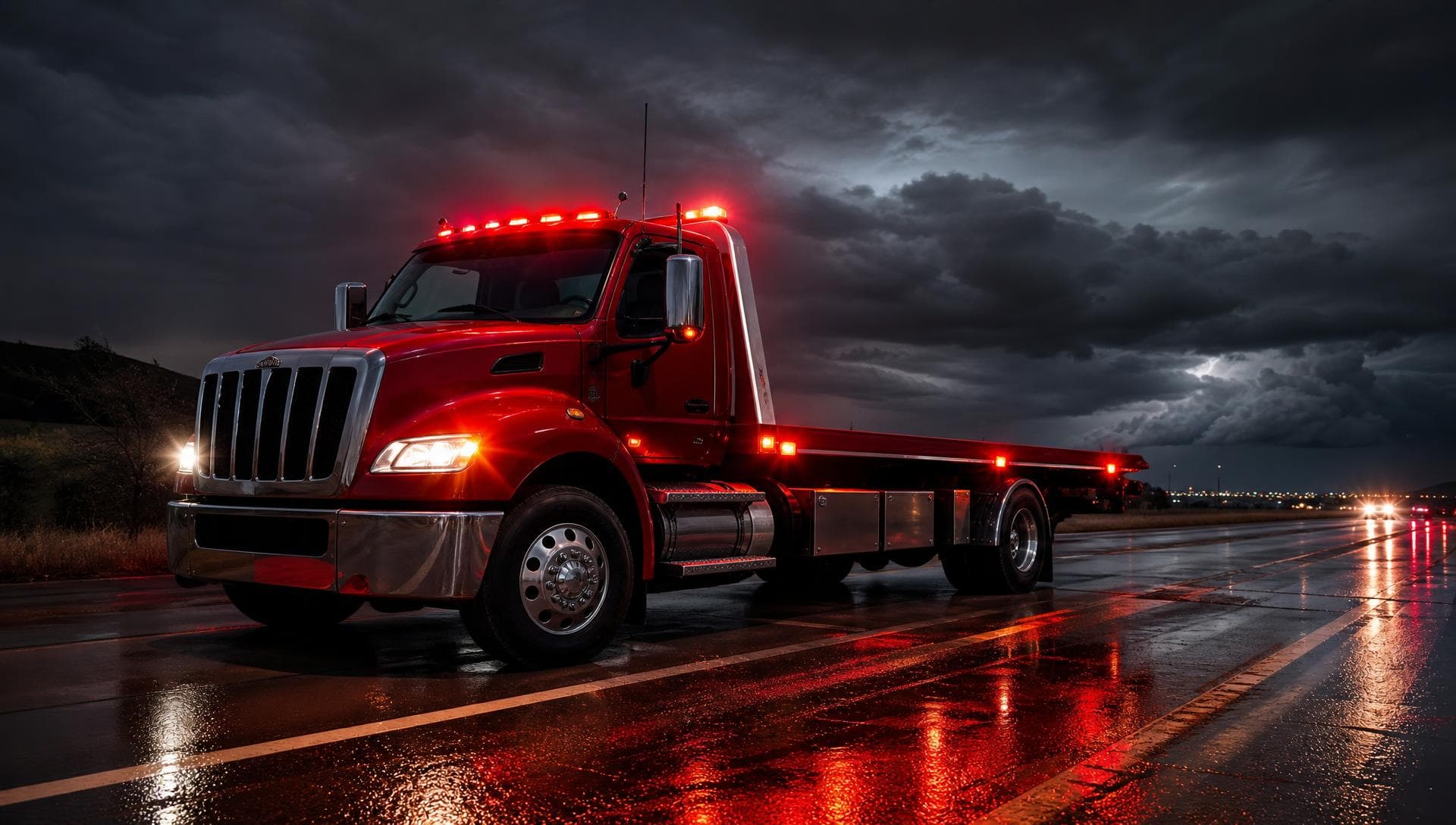
Can you tow a Tesla? Yes, on a flatbed with all four tires off the ground. Tesla's own instructions say the motors generate power whenever the wheels spin, so a wheel-lift tow that leaves two tires rolling can overheat the drive unit and cause serious damage, and the warranty does not cover it. The same rule applies to most all-wheel-drive cars for a different reason: the drivetrain links all four wheels, and dragging two of them damages the transmission.
In Round Rock and Cedar Park, where EVs are thick on the ground, this is now the most common "wrong truck" problem in towing. Here is what the manufacturers require, in their words, and what to tell dispatch so the right truck shows up.
Can you tow a Tesla with a regular tow truck?
Not with the wheels down. Tesla's Instructions for Transporters are specific, and they are the same across Model 3, Model Y, Model S and Model X.
- All four tires off the ground. The motors generate power when the wheels spin. Transporting with any tire on the ground can cause significant damage and overheating.
- A flatbed is the recommended method. The vehicle can face either direction on the deck.
- Tow Mode first. Enable Tow Mode before winching the car onto the flatbed, so the parking brake releases and the car can roll.
- Dollies only as a last resort. If a flatbed is not available, wheel lifts and dollies must raise all four wheels, for a maximum of 35 miles, and never above the dollies' speed rating.
- No warranty cover. Damage caused by improper transporting of the vehicle is not covered by the warranty.
Source: Tesla, Model 3 Owner's Manual, Instructions for Transporters
The 35-mile dolly limit is the detail that matters locally. From the Round Rock Outlets to a service center in south Austin is further than that. A wheel-lift with dollies is a short-hop tool; for an EV going anywhere real, it is a flatbed or nothing.
How many EVs are on Texas roads, and why it matters when you call a tow
Texas had 387,400 registered electric vehicles and another 79,900 plug-in hybrids in 2025, according to the U.S. Department of Energy's Alternative Fuels Data Center. Add more than a million conventional hybrids, many of them all-wheel-drive, and a large share of the cars on I-35 cannot be towed the old way.
Source: U.S. Department of Energy, Alternative Fuels Data Center, Texas vehicle registration counts (2025)
The practical effect is on the phone call. A dispatcher who does not ask what you drive will send whatever truck is closest. A dispatcher who asks "is it electric or all-wheel-drive?" is deciding which truck rolls. Say it before they ask: the make, the model, and whether it has power. That one sentence is the difference between a tow and a drivetrain repair.
Why can't an all-wheel-drive car go on a wheel-lift?
Because in an AWD system all four wheels are mechanically linked. Lift two and drag two, and the center differential and transmission are forced to make up a difference that never happens in normal driving. Manufacturers put it bluntly.
| Manufacturer | Rule | If wheels stay on the ground |
|---|---|---|
| Tesla (all models) | All four tires off the ground. Flatbed recommended | Significant damage and overheating. Not covered by warranty |
| Mazda (AWD models) | Always tow an AWD vehicle with all four wheels off the ground | The drive train could be damaged, or the vehicle could trail away from the tow truck |
| Subaru (CVT and automatic) | Flatbed is the recommended method | Wheels-down towing limited to 20 mph and 31 miles, or transmission damage will result |
| Subaru BRZ, Crosstrek Hybrid | Flatbed with all four wheels off the ground only | No wheels-down allowance at all |
Source: Subaru of America TechTIPS, June 2023 (towing guidance by model), published via NHTSA
Source: Mazda USA, 2026 CX-50 Owner's Manual, Having the Vehicle Towed
Subaru's bulletin is worth reading closely because it is the one that gives a number. A CVT Outback or Forester can be moved a short distance with the wheels down, but 31 miles at 20 mph is a crawl across town, not a tow. And the bulletin is explicit that the BRZ and the Crosstrek Hybrid get no allowance at all. If you are not sure which rule your car falls under, the safe answer is always the flatbed, because the flatbed is correct for every vehicle on this list.
Which other cars need a flatbed?
The EV and AWD rules are the ones written in manuals. Experience adds a few more categories where a wheel-lift is the wrong tool even when it is technically allowed.
- Lowered and sports cars. Wheel-lift forks and the approach angle scrape front lips and splitters. A flatbed with ramps or boards does not.
- Luxury, exotic and classic cars. Nothing should touch the body or the frame. Soft straps at the wheels on a flat deck is the only method that guarantees it.
- Collision damage. A car that cannot roll straight or steer cannot be wheel-lifted safely. Accident recovery is winched onto a deck.
- A dead car with a locked steering column or a stuck parking brake. The winch pulls it on regardless of whether it can roll.
- Motorcycles. Chocked and soft-strapped on the deck, never laid over. Motorcycle towing is flatbed by definition.
- Any long-distance move. A wheel-lift tow across Texas puts hundreds of miles on a drivetrain that is not running. A flatbed puts zero.
The scale of this is not small. Of the more than 27 million roadside calls AAA answered in 2024, roughly 13 million ended in a tow. A meaningful share of those vehicles were EVs or AWD, and every one of them needed the operator to know the difference.
Source: AAA Newsroom, April 2025 (2024 roadside call and tow volume)
How does a flatbed load an EV that won't move?
The procedure is the same whether the car is a Model Y with a dead 12-volt battery or a Subaru with a seized transmission. The difference is in the first step.
- 01Free the parking brake. On a Tesla that means Tow Mode, which needs low-voltage power. If the 12-volt battery is dead, the operator follows the manufacturer's procedure to power it before anything is pulled. On a conventional AWD, it means neutral and the brake released.
- 02Tilt and slide the deck. The bed angles down to meet the car. On a lowered car, boards extend the ramp to kill the approach angle.
- 03Winch, do not drive. The winch line attaches at the manufacturer's tow point, never at suspension or body, and pulls the car up at walking pace.
- 04Strap at the wheels. Soft straps over each tire, tensioned to the deck. Nothing touches paint, frame or battery pack.
- 05Level transport, level delivery. Off the deck the same way it went on, at the shop or driveway you chose.
If your EV is in an underground garage, say so on the call. Low clearance can keep a flatbed out, and dispatch will plan the pickup from the ramp or the street rather than waste a trip. The same goes for a tight apartment lot in Round Rock or Cedar Park.
What to tell dispatch when your EV or AWD breaks down
Five things, in this order. They take fifteen seconds and they decide which truck comes.
- Make and model. "Tesla Model Y" or "Subaru Outback" tells the dispatcher the rule before you do.
- Drive type, if it is not obvious. AWD, 4WD, electric, hybrid.
- Does it have power? A Tesla with a dead 12-volt battery, or a car that will not shift out of park, changes the loading plan.
- Where exactly it is. Garage level, parking space, shoulder of I-35 with the nearest exit, or the mile marker on SH-130.
- Where it is going. The service center, your mechanic, or home. You choose the destination.
If you are on the highway, the I-35 breakdown guide covers staying safe until the truck arrives. If you plan to file with your insurer, the insurance guide explains what the receipt needs to show.
Flatbed towing with YAS Towing in Pflugerville, Round Rock and Cedar Park
YAS Towing runs flatbed and wheel-lift trucks from Pflugerville, and every EV, hybrid and all-wheel-drive vehicle goes on the flatbed, full stop. Dispatch asks what you drive on every call so the right truck is the one that rolls. Tow Mode, soft straps at the wheels, manufacturer tow points, and a level ride to the destination you name.
For a Tesla going to a service center, a lowered car going to a shop, or an AWD that will not shift, call dispatch 24 hours a day and say what it is. The flatbed is already the plan.
Questions
Frequently asked
No. Tesla requires all four tires off the ground. If a flatbed is unavailable, wheel lifts and dollies that raise all four wheels may be used for a maximum of 35 miles and only within the dollies' speed rating. Any transport with a tire rolling risks drive-unit damage that the warranty excludes.
A flatbed tow does not use the battery at all. The danger is the opposite: if the wheels spin during transport, the motors generate power and heat with nowhere to go, which is why Tesla requires the tires off the ground. Tow Mode uses the low-voltage system only to release the parking brake.
Only certain models with the 6-speed split-case manual transmission, in neutral with the key in ACC, according to Subaru's 2023 TechTIPS bulletin. CVT and automatic models are limited to 20 mph and 31 miles with wheels down, and the BRZ and Crosstrek Hybrid must be on a flatbed with all four wheels up. Check the owner's manual for your exact model and year.
Tesla states that damage caused by improper transporting is not covered by the warranty, and other manufacturers take the same position on drivetrain damage from towing against the manual. The repair bill lands on whoever authorized the tow, which is one more reason to say "flatbed" on the call.
Published Oct 27, 2026. Last reviewed Oct 27, 2026 against the sources linked above. Texas fee caps and statutes change; confirm the current figures with the Texas Department of Licensing and Regulation before relying on them. This article is general information, not legal advice.