
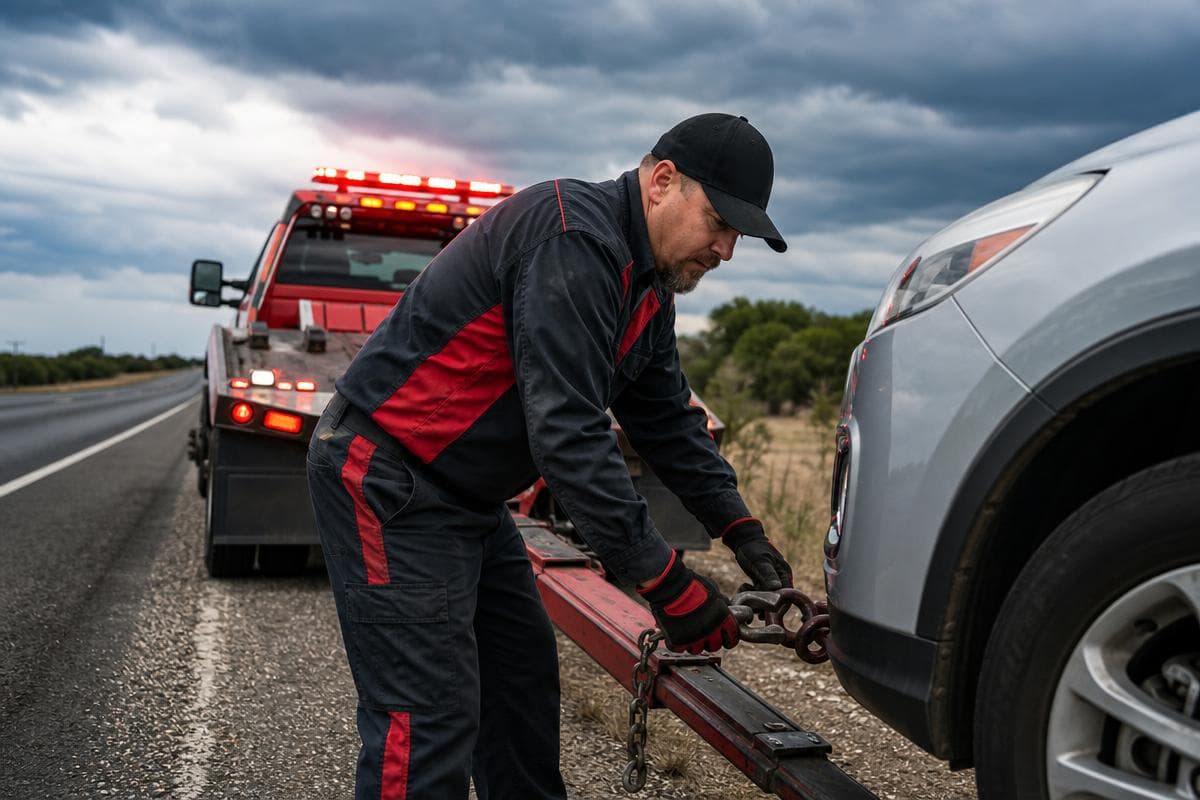
Does car insurance cover towing? In Texas, not by default. The minimum policy the state requires is liability only, and it pays for other people's damage, not your tow. Towing is covered when you have added towing and labor coverage, sometimes sold as roadside assistance, or when the tow is part of a collision or comprehensive claim. Each of those has limits that decide what you actually get back.
The time to learn those limits is before the breakdown, not on the shoulder. This guide uses the Texas Department of Insurance and the Office of Public Insurance Counsel as the sources, so you can check every line against your own declarations page.
Does car insurance cover towing in Texas by default?
No. Texas law requires 30/60/25 coverage: $30,000 for injuries per person, $60,000 per accident, and $25,000 for property damage. That is liability insurance, and it pays for what you do to other people and their property. It does not pay to move your own car.
The Texas Department of Insurance lists towing and labor as one of eight basic auto coverages, and says plainly that beyond the required liability coverage, you can choose whether to buy the others. So if nobody added it to your policy, it is not there, and a tow is out of pocket until you file under something else.
Find out in thirty seconds: open your declarations page and look for a line called towing and labor, roadside assistance, or emergency road service. If it is there, it will show a dollar limit per disablement. If it is not, keep reading, because collision and comprehensive may still help after a crash.
What does towing and labor coverage actually pay for?
TDI's definition is one sentence: towing and labor pays to tow your car if it cannot be driven, and pays for labor to change a flat tire or jump-start your battery. The Office of Public Insurance Counsel spells out the limits insurers attach to that sentence, and they are where most claims come up short.
| Service | What is typically covered | The usual limit |
|---|---|---|
| Towing | Towing the vehicle if it cannot be made drivable at the scene | Often only to the nearest repair facility, with a distance or dollar cap |
| Tire change or jump start | The labor to do it at the roadside | Labor time (one hour is a common example) or a dollar amount |
| Fuel, oil or fluid delivery | The delivery itself | You usually pay for the fuel or fluid |
| Extrication (winch-out) | Pulling the vehicle back to the road | Only if the vehicle is on or close to a public road. Dirt roads, fields and pastures are usually excluded |
| Lockout | Getting you back into the car | A labor-time or dollar limit, $100 is a common example. Some policies do not pay for a locksmith |
Source: Texas Office of Public Insurance Counsel, Know Your Coverage: Roadside Assistance
Two of those rows decide most arguments. Nearest repair facility means a tow to the dealer you trust across town may be reimbursed only as far as the closest shop, with the rest on you. And the public road rule means a winch-out from a muddy field or a ranch road is usually not covered at all, even with roadside assistance on the policy.
What this looks like on the ground: a jump start or tire change on I-35 is squarely inside the coverage. A fuel delivery is covered for the trip, not the gallons. A lockout is covered up to the limit, which is usually enough for a car but not always for a locksmith on a high-end key.
Will collision or comprehensive pay for the tow after a crash?
Often, as part of the claim, but neither coverage is written for towing. TDI defines collision as paying to repair or replace your car after an accident, and comprehensive as paying if your car is stolen or damaged by fire, flood, vandalism or something other than a collision. A tow from the scene to the body shop is normally handled as a cost of that claim, subject to your deductible, which is why the adjuster will want to know where the car went and why.
The number of people in this situation is not small. AAA alone answered more than 27 million roadside calls in 2024, and roughly 13 million of them ended in a tow.
Source: AAA Newsroom, April 2025 (2024 roadside call volume)
Three things protect you after a crash. Choose your own tow company and your own body shop, since a truck that shows up uninvited at the scene is the start of most towing disputes. Tell dispatch you will be filing a claim, so the receipt is written for it. And photograph the car before it is loaded. Accident recovery done right gives the adjuster nothing to argue with.
Reimbursement or direct pay: how a towing claim actually works
Some insurers dispatch and pay the tow company directly through their own roadside line. Others reimburse you after you pay. The Office of Public Insurance Counsel lists four restrictions that trip people up with either model.
- Prior approval. Some companies pay less if you did not get approval before getting help. If your policy says that, call the insurer's roadside number first, or at least before the truck is dispatched.
- Claims per policy period. A cap on how many roadside events they will pay for in a year. Three or four is common.
- Vehicle age or mileage. Some companies stop offering roadside coverage once the car passes a certain age or mileage.
- Receipt deadlines. A time limit for submitting receipts for reimbursement. Miss it and the claim is gone.
The receipt is the whole claim. For a tow you ordered yourself, ask for an itemized receipt showing the date, the pickup and drop-off locations, the service performed and the company's name and phone. Texas already requires that level of detail on every non-consent tow ticket, including the company's licensed name, phone number and TDLR certificate number, and a company with nothing to hide will give you the same on a consent tow without being asked.
Source: TDLR, Consumer Information about Towing (tow ticket requirements)
Do you need roadside coverage if you have AAA, a credit card or a new car?
Maybe not, and the state's own advice is to check before you buy it twice. OPIC points to three places people already have roadside help without knowing it.
- The manufacturer. Many new vehicles come with roadside assistance for the warranty period. Check the owner's packet or the brand's app.
- Credit cards and clubs. OPIC notes that some credit cards and clubs provide roadside benefit services too. Premium cards often include a few tows a year.
- Free local services. OPIC specifically cites the HERO Roadside Assistance Program in the greater Austin area, which handles minor problems on covered freeways at no charge. The I-35 breakdown guide has the number.
The practical rule: if you already have one of those, roadside coverage on the policy is a backup, not a necessity. If you have none of them and you drive I-35 or SH-130 every day, it is some of the cheapest coverage on the policy. Either way, write the roadside number into your phone now, because the plan only works if you can find it from the shoulder.
What roadside coverage does not pay for
The same OPIC page is clear about the gaps, and they are the same across most policies.
- The fuel or fluid itself, only the delivery.
- A winch-out away from a public road: dirt roads, gravel, fields, pastures.
- A locksmith, on some policies, even when the lockout labor is covered.
- Distance beyond the nearest repair facility, on policies written that way.
- Anything after the claim cap for the policy period is used up.
- Parts and repairs. Roadside coverage gets the car moving or moved; it does not fix it.
None of that makes the coverage bad. It makes it specific. Knowing which row you are in before you call means you can ask the right question: "Is this covered, and to where?" If the answer is a tow you will pay for yourself, what towing costs in Texas explains what to expect and what to refuse.
Using your coverage with YAS Towing in Pflugerville and Round Rock
YAS Towing is a Pflugerville tow company covering Round Rock, Hutto, Georgetown and Cedar Park, 24 hours a day. When you call, say whether you will be filing a claim and whether your insurer needs to approve the tow first. Dispatch will ask for the destination you want, not the nearest one, and the receipt will show the date, the route and the service so the adjuster has what they need. The car goes where you say.
If your insurer dispatches through its own roadside network, you can still ask for us by name. If you are paying and filing later, send the details after the job and we will make sure the paperwork is complete.
Questions
Frequently asked
"Full coverage" usually means liability plus collision and comprehensive. Towing and labor is a separate line, so full coverage does not automatically include roadside assistance. After a crash, the tow is often handled as part of the collision claim, but a breakdown tow with no accident needs towing and labor coverage or comes out of pocket.
Not always. The Office of Public Insurance Counsel notes that coverage may only include towing to the nearest repair facility, with a distance or dollar limit. You can still choose your shop; you may just pay the difference beyond the covered distance.
Pay the company, keep the itemized receipt with the date, pickup and drop-off locations, service and company details, and submit it to your insurer inside the time limit on your policy. If your policy requires prior approval, call the insurer before the tow or expect a reduced payment.
If you have no manufacturer program, no credit-card roadside benefit and no auto club, it is inexpensive protection against a breakdown. If you already have one of those, it is a backup. Check what you have first; the state's advice is to know your coverage before you are stranded.
Published Oct 27, 2026. Last reviewed Oct 27, 2026 against the sources linked above. Texas fee caps and statutes change; confirm the current figures with the Texas Department of Licensing and Regulation before relying on them. This article is general information, not legal advice.