
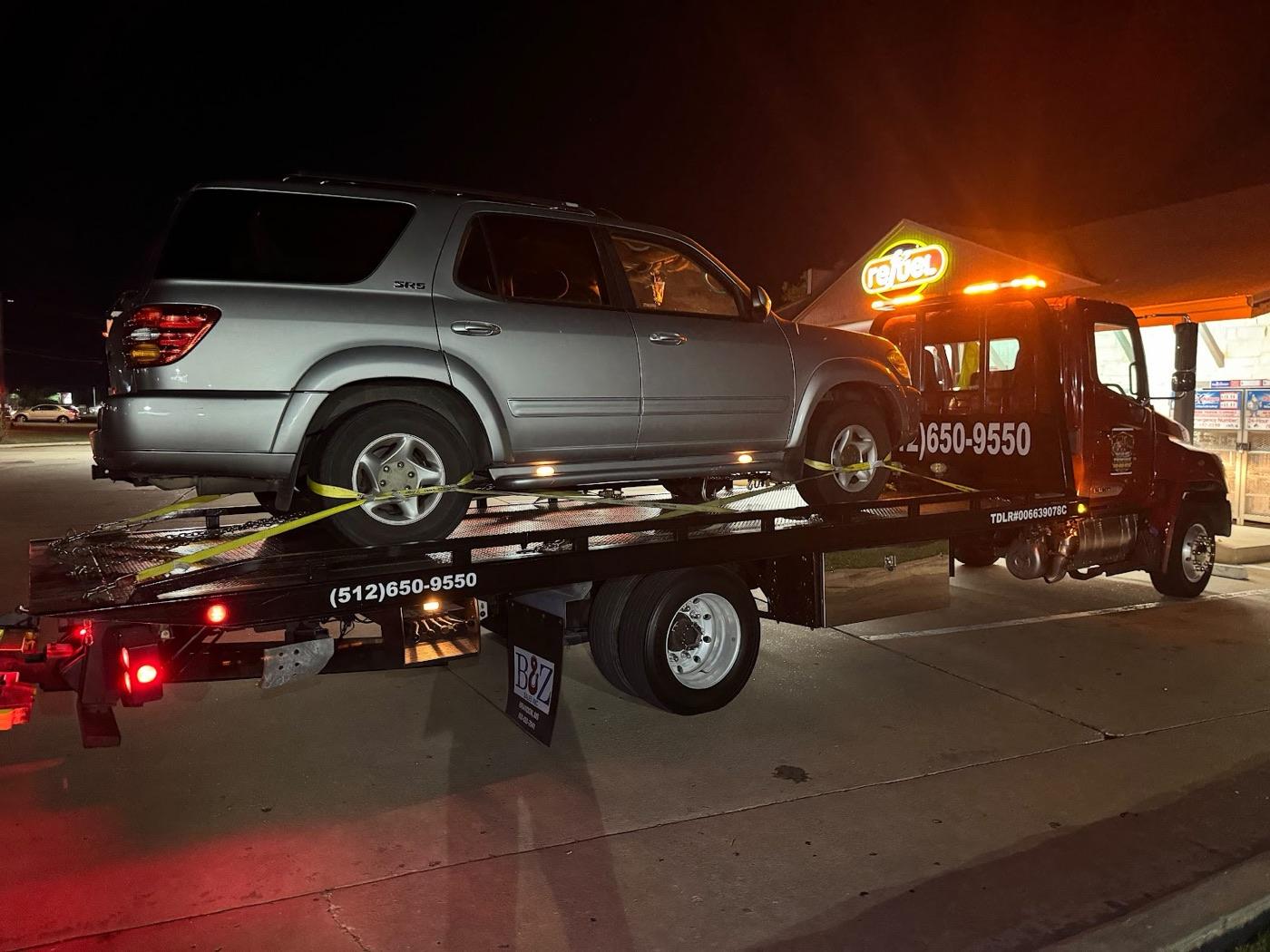
What to do after a car accident in Texas is set by state law, and it is short: stop, check whether anyone is hurt, call 911 if they are, get drivable cars out of the freeway lanes, and trade information with the other driver. One decision is left to you: where the car goes, and who tows it.
This guide covers the first 30 minutes of a crash on I-35 around Round Rock and Pflugerville. It is general information, not legal or medical advice. If anyone is injured, call 911 first.
What to do after a car accident in Texas, step by step
Stop, check for injuries, call for help, clear the lanes if the cars can move, then exchange information. TxDOT counted one reportable crash every 59 seconds in Texas in 2025, with 244,534 people injured.
Source: TxDOT, Texas Motor Vehicle Traffic Crash Facts 2025 (crash frequency, injuries)
- 01Stop at the scene, or as close as you can. Driving away from a crash that hurt someone or damaged an occupied vehicle is an offense.
- 02Check everyone and call 911 if anyone is hurt. The law requires reasonable assistance, including arranging transport to a hospital when treatment is clearly needed.
- 03Hazards on. If nobody is hurt and the cars drive, leave the main lanes.
- 04Trade information and take photos once you are out of traffic.
- 05Decide where the car goes. If it cannot be driven, name the tow company and the destination yourself.
- 06Tell your insurer soon. The Texas Department of Insurance (TDI) notes that most companies have claim deadlines.
Source: Texas Transportation Code, Sections 550.021 to 550.023 (duties after a crash)
Do you have to move your car after an accident on I-35?
Yes, when nobody is hurt and every vehicle can still be driven. Section 550.022 says that after a crash on a main lane, ramp, shoulder or median of a freeway in a metropolitan area, each driver must move as soon as possible to a designated collision investigation site, a frontage road, the nearest suitable cross street or another suitable location.
A car can be "normally and safely driven" only if it does not need a tow and runs under its own power in its usual manner. Not moving when you could is a Class C misdemeanor. On I-35 through Round Rock and Pflugerville, the frontage road at the next exit is usually the closest place the law names.
Source: Texas Transportation Code, Section 550.022 (moving off a metropolitan freeway)
If someone is hurt, or the car will not steer, stay put, keep the hazards on and call 911. The I-35 breakdown guide covers where to wait. Passing drivers must move over or slow to 20 mph below the limit for a stopped emergency vehicle or tow truck with its lights on. Since September 1, 2023, a first offense carries a fine of $500 to $1,250.
Source: Texas Legislature, HB 898 bill analysis (Move Over fines)
Do you have to call the police after a car accident in Texas?
Yes, immediately, if anyone is injured or killed, or if a vehicle cannot be normally and safely driven. Section 550.026 requires notice "by the quickest means of communication" to the local police department inside a city, or to the sheriff or DPS outside one. On I-35, that means 911.
| Situation | What you must do | Section |
|---|---|---|
| Someone is injured or killed | Stop, give reasonable assistance, notify police immediately | 550.021, 550.023, 550.026 |
| A vehicle cannot be safely driven | Notify police immediately, even with no injuries | 550.026 |
| Damage only, cars drivable, metro freeway | Move off the freeway, then exchange information | 550.022 |
| You hit an unattended vehicle | Find the owner, or leave a note with your name, address and what happened | 550.024 |
| You hit a structure, fixture or landscaping by the highway | Take reasonable steps to notify the owner | 550.025 |
Source: Texas Transportation Code, Sections 550.021 to 550.026 (driver duties)
For a minor crash with no injuries and drivable cars, that immediate-notice rule does not apply, but you still must stop and exchange information. An officer who investigates must file a written report when the crash caused injury, death or apparent damage of $1,000 or more to any one person's property.
Source: TxDOT, Crash reports and records (officer's report threshold)
What information do you have to exchange after a crash in Texas?
Your name and address, your vehicle's registration number, and the name of your liability insurer. If the other driver asks and you have it with you, you must also show your driver's license.
Source: Texas Transportation Code, Section 550.023 (duty to give information)
That is the legal minimum. TDI's list for a claim is longer:
- The other driver's phone number, license plate, exact insurance company name and policy number. Photograph the insurance card. If the driver refuses to name an insurer, TDI says to call the police.
- Names and phone numbers of witnesses.
- The time, date and exact location, plus weather and road conditions.
- Pictures of the scene.
- The officer's name and badge number.
Texas requires at least 30/60/25 liability coverage: $30,000 for injuries per person, $60,000 per accident and $25,000 for property damage. It pays the other side when you are at fault. What pays for your own tow is a separate question.
Source: Texas Department of Insurance, Auto insurance guide (30/60/25, claim tips)
Can you choose your own tow truck after an accident in Texas?
Usually, yes. Section 545.305 lets an officer remove a disabled vehicle when the owner "does not designate a particular towing or storage company", so name one. The limit is safety: an officer can order a hazard moved, and police or fire crews may clear anything blocking the roadway without the owner's consent.
Source: Texas Transportation Code, Sections 545.305 and 545.3051 (removal of vehicles)
A consent tow is summoned by the vehicle's owner or operator. An incident management tow is summoned to a collision scene and counts as a nonconsent tow. After any tow from a traffic accident, TDLR says you are entitled to a copy of the tow ticket, which must itemize each charge and show the company's licensed name, phone number, certificate of registration number and the operator's TDLR license number.
Source: Texas Occupations Code, Section 2308.002 (tow definitions)
Source: TDLR, Consumer Information about Towing (tow ticket)
Then there is the truck nobody called. TDI calls it a towing scam: a driver shows up without being called by you or police, recommends a specific shop, and later a bill arrives for thousands of dollars in storage and other fees. TDI's advice: confirm the truck is the one you or police called, read anything you are asked to sign, know where the car is going, and get a receipt showing the towing fee. Report problems to TDLR.
Source: Texas Department of Insurance, Don't fall victim to a towing scam
Tell dispatch how the car sits. One that cannot roll needs a flatbed, one off the pavement needs a winch-out first, and the EV and all-wheel-drive guide covers the rest.
How do you get a copy of a Texas crash report?
Buy it from TxDOT's Crash Report Online Purchase System, which emails the Texas Peace Officer's Crash Report (CR-3) after purchase. TxDOT lists $6 for a regular copy and $8 for a certified one. Officers have until the tenth day after the crash to file it.
TxDOT no longer retains the Driver's Crash Report (Form CR-2), no longer provides the form, and destroys any CR-2 sent to it. If a local agency gives you one after a crash no officer investigated, keep it for your records.
Source: TxDOT, Crash reports and records (CR-3 costs, CR-2 status)
Accident towing with YAS Towing in Round Rock and Pflugerville
YAS Towing is a Pflugerville company running flatbed and wheel-lift trucks 24 hours a day across Round Rock, Pflugerville, Hutto, Georgetown, Cedar Park and north Austin. Call for accident recovery and dispatch gives you a real ETA on the call. Arrival averages about 30 minutes across the core area. YAS is licensed and insured, and it does not impound cars or run a storage lot: the car goes from the scene to the body shop, dealer or driveway you name.
Have three things ready: where you are (highway, direction, nearest exit), whether the car rolls and steers, and where it is going. Ask dispatch for a quote on the tow. For questions after the job, contact us.
Questions
Frequently asked
It is a crime. Under Section 550.021, leaving a crash that caused a death is a second-degree felony, and serious bodily injury makes it a third-degree felony. With vehicle damage only, Section 550.022 makes it a Class C misdemeanor under $200 in damage and a Class B misdemeanor at $200 or more. This is not legal advice.
Call the police. TDI warns that uninsured motorist coverage will not pay for a hit-and-run you did not report to police. The same coverage pays when the driver who hit you had no insurance or not enough. Texas insurers must offer it, and declining it has to be done in writing.
TDI says a liability-only policy leaves the towing and storage bill with you, while a policy that also covers damage to your own car will pay reasonable towing and storage fees. If the other driver caused the crash, that driver's insurer might pay them. Keep the receipt either way.
Yes, in some situations. Section 545.305 allows an officer to remove a disabled vehicle when the owner is incapacitated, is not nearby or does not designate a towing company, or when the vehicle is a hazard. The owner is liable for reasonable towing and storage fees, and is still entitled to a copy of the itemized tow ticket.
Published Nov 11, 2026. Last reviewed Nov 11, 2026 against the sources linked above. Texas fee caps and statutes change; confirm the current figures with the Texas Department of Licensing and Regulation before relying on them. This article is general information, not legal advice.